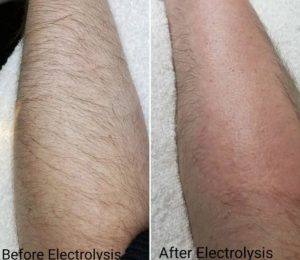
WHAT IS ELECTROLYSIS HAIR REMOVAL?
Electrolysis or electric hair removal is a safe and effective way to get rid hair for good.
Practiced and it is particularly indicated where laser treatment is not or no longer effective, such as areas of the face, or hormone-dependent areas at risk of paradoxical regrowth.
How does electric hair removal work?
The technique works hair by hair: the practitioner inserts a very fine, single-use needle into the hair follicle beneath the skin’s surface, then sends an electric current to destroy the hair root. Destruction is definitive: the conductive hair falls out immediately and will not grow back!
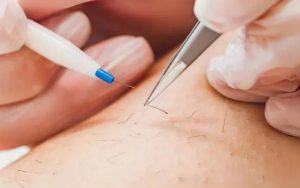
Which areas should be treated with electrolysis?
Because it’s time-consuming and tedious,electric hair removal is best undertaken on small areas, or as a finishing touch to laser hair removal.
Electrolysis is also recommended for areas at risk of stimulation or paradoxical regrowth.
For women, i recommend it for the treatment of the following areas:
- Hormone-dependent areas of the face: chin, cheeks, sideburns
- neck and nape
- underarms
- arms and legs
- buttocks
- upper thighs bikinis zone.
For men, when hair growth has not yet reached maturity (over the age of 30), it may be worthwhile to start a permanent hair removal treatment with electrolysis rather than laser, to avoid any risk of paradoxical regrowth. The areas most susceptible to this side effect and for which electrolysis is recommended are :
- cheekbones
- torso
- upper back and shoulders
Electrolysis is also effective for the treatment and prevention of folliculitis (ingrown hairs) in all areas.
The benefits of electric hair removal
Unlike laser technologies,electrolysis is not limited to dark hair: the treatment is therefore suitable for light hair, whether white, blond, red …
It is also the only method capable of eradicating hair devoid of melanin.
Because electrolysis targets only one hair per electrical impulse, there is no risk of stimulation or paradoxical regrowth.
Another notable advantage is that the sun is not a contraindication, so electric hair removal can be performed safely all year round.
How many sessions are required for electric hair removal?
The hair growth cycle oscillates between 4 and 24 months. This is exactly how much time it will take to completely remove ALL UNWANTED HAIR !!
This cycle consists of 3 phases:
- growth phase (anagen): hair growth
- resting phase (catagen): the hair is at its adult size and ceases to evolve
- death phase (telogen): the hair dies, giving way to a new hair follicle, and the hair cycle begins again.
Treatment is most effective during the growth phase.
Because each hair is not in the same phase, and it is not possible to determine which phase it is in, it is therefore necessary to carry out several sessions to cover the entire hair cycle.
It is generally advisable to carry out sessions every 2 to 3 weeks at the start of treatment, then to space out as the targeted area grows back.
How does a session work?
The electrologist, in agreement with the patient, defines the treatment area and disinfects the skin beforehand with an antiseptic solution. He then places a plate (it’s can be bracelet) of return electrodes on the patient’s to secure the session.
It’s important that the hair is of a certain length (minimum 3-4 mm) so that the practitioner can grasp it and insert the conductive filament into the hair follicle.
The length of the session is defined beforehand according to the size of the desired area, its complexity, and the patient’s resistance to the sensation of the technique.
At the end of the treatment, a soothing and healing cream is applied. Redness and/or papules may appear in the following hours, and will fade on their own within 24 hours.
In rare cases, hematomas may form. Don’t worry though, this side effect is transitory, and will resolve itself in about 7 days.
Thin skin may develop scabs at the filament insertion point, which will fall off within 15 days of the treatment.
Contraindications to electrolysis
- Pregnant woman
- Heart disease
- People with diabetes or on insulin treatment
- People undergoing chemotherapy or radiotherapy
- Current photosensitizing treatment (acne medication)
- People with IUDs or metal implants
RECOMMENDATIONS FOR FACIAL SKIN CARE AFTER ELECTROLYSIS PROCEDURE
- Do not wet the treated area for 24 hours.
- On the first day after the procedure, treat the treated area with Chlorhexidine every 2 hours.
- For next 2–5 days, treat the treated skin area twice a day (morning and evening): first with Chlorhexidine, then with powder Baneocin or Panthenol spray (as prescribed by the specialist), until the skin is completely restored.
- Do not touch the treated area with unwashed hands or let it come into contact with clothing. It is advisable to wear a mask immediately after the procedure to avoid infection and inflammation.
- Do not apply creams or cosmetics to your skin for 5 days. Otherwise, you may create a favorable environment for bacterial growth. Use only products recommended by the electrologist, as well as special creams with SPF.
- It is strictly forbidden to sunbathe or expose the skin to sunlight until the scabs have completely disappeared, as this may result in pigmentation spots. After the skin is fully restored, use an SPF cream for one month.
- Avoid sports, visiting saunas, taking hot baths, swimming in chlorinated water, or swimming in any body of water during the first week after the procedure.
- Redness and swelling may last from 1 hour to 2 days (especially after the first procedures).
RECOMMENDATIONS FOR BODY SKIN CARE AFTER ELECTROLYSIS PROCEDURE.
- Do not wet the treated area for 24 hours.
• Treat the treated skin area twice a day (morning and evening) for the first 2 days: with
Chlorhexidine,
• Afterward, switch to moisturizing and restorative products (creams, gels, foams, lotions, or emulsions).
Examples: Panthenol spray, Sterex gel, Lipikar (La Roche-Posay) , Atoderm, or Cicabio (Bioderma).
• Do not touch the treated area with unwashed hands to prevent infection or inflammation.
• Avoid applying creams or deodorants to the treated area. Otherwise, you may create a favourable environment for bacterial growth.
• Deodorant should be avoided for 7–10 days and replaced with baby powder (fragranced versions are acceptable).
• Avoid creating a moist environment in the treated area during the first 3 days (e.g., sweating) and prevent friction (tight clothing or intense physical activity).
• It is strictly forbidden to sunbathe or expose the skin to sunlight until all scabs have completely disappeared, as this may lead to pigmentation spots.
• Avoid sports, saunas, hot baths, swimming in chlorinated water, or any bodies of water during the first week after the procedure.
• Wear loose-fitting clothing to avoid irritation on the treated area. Ensure that clothing seams do not come in to contact with the treated zone.
Recommendations for Preparing the Skin Electrolysis Procedure.
The recommended hair length should be no less than 1 mm and no more than 4 mm. Hair that is too short or too long makes it harder to target the follicle with the electrode, prolonging the procedure.
One day before the procedure, take a bath and exfoliate (scrub) the area where electrolysis treatment will be performed.
After exfoliation, moisturize the skin with a cream.
We recommend avoiding alcohol consumption at least 24 hours before the procedure.
A few days before the procedure, increase your water intake to 2 litres per day.
It is advisable to schedule the procedure immediately after menstruation, when the pain threshold is higher.
Before the procedure, please take a shower. If this is not possible, use wet wipes.
Use a tampon if the procedure is being done in the bikini area.
Consultation – € 15
In order to ensure that Electrolysis is the best hair removal treatment for you, I encourage that you book a consultation .Before we start the electrolysis process, I will give you a 10 minute sample treatment, to determine your pain levels. If necessary, we can use anesthetic cream.
Price: 60 min – €60